
The Red Rabbit
Or: “How to Explain Pictures to a Dead Rabbit”
On Expanding the Concept of Art: Why Cologne owes the LOFT to Sigmar Polke.
Under the title: Alibis: Sigmar Polke. Retrospective, March 14 to July 5, 2015, the Museum Ludwig in Cologne hosted an exhibition of Sigmar Polke’s work
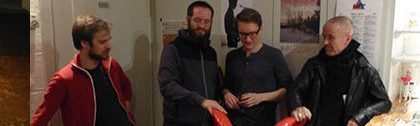
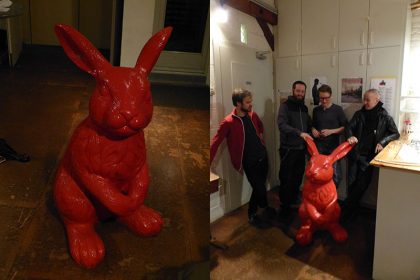
In February 2015, I was in Ghent with my wife – at the “Friday Market,” a large red rabbit caught my eye – on display alongside many other sculptures and animals. Visitors to the LOFT over the past two months are already familiar with it. I bought it (actually her – since it’s a female rabbit named Erna) because, as someone from the Lower Rhine and a Beuys fan, I immediately thought of the association “red-dead” and thus Joseph Beuys’s 1965 action at the Schmela Gallery in Düsseldorf, which bore the title:
„Wie man dem toten Hasen die Bilder erklärt“
“The performance is considered the culmination of Joseph Beuys’ development of an expanded concept of art, a process that began as early as his drawings of the 1950s. With detachment and irony, he celebrates the ritual of ‘explaining art’ through his performance, which is, in effect, silent (to the audience).” (Wikipedia)
 But what does this have to do with the LOFT and Sigmar Polke?
The first LOFT was located in 1986 not far from the music academy, in a courtyard on Unter Krahnenbäumen Street. Starting in April, I converted a small factory floor there so I could work and host small concerts, following in the footsteps of Walter Zimmermann’s “Studio Beginner,” which had just closed. The landlord told me that an artist (Sigmar Polke) lived and worked above me, though he wasn’t in Cologne at the moment. He was in Venice at the time, designing the German Pavilion for the Biennale, for which he later won the “Golden Lion” and was celebrated on the cover of “Der Spiegel” as the “alchemist among artists.”
Back in Cologne, Sigmar Polke immediately felt disturbed by my musical activities taking place below him, but he had little chance of getting rid of me, since it was a commercial building and not a residential one. The landlord called me repeatedly, and finally I told him, “We’re not talking about problems – we’re talking about solutions and money!” Since I had also had a minor “physical altercation” with Sigmar Polke in the meantime, his partner took over the negotiations and approached me about a financial solution to the problem, suggesting that I give them all the receipts for the renovations and investments – they would reimburse me for the costs and take over the (long-term) lease. I said that would be a good idea, but in return I would want Sigmar Polke to paint seven pictures for me; I would, of course, cover the cost of the materials needed for that.
“An incomprehensible silence.” “By what right is my work merely ‘material’?” I replied, pointing out that I, for example, create spaces for art and for artists, and that I found their definition of art for artists astonishingly narrow.
Of course, I never received the seven paintings (unfortunately), but after my tax advisor took over the negotiations, a settlement was ultimately reached for such a large sum that I was able to begin the renovation work on what is now the LOFT on Wissmannstr in 1987.
HM Müller, 04/2015